
Breaking Down Tariffs and the Trade Thaw
Breaking Down Tariffs and the Trade Thaw
CCBC members receive a weekly policy and market briefing highlighting developments shaping Canada–China trade and investment.
Below is a sample excerpt from a recent briefing provided to members on tariff adjustments affecting Canadian exports to China. CCBC members receive the full briefing directly in their inbox.
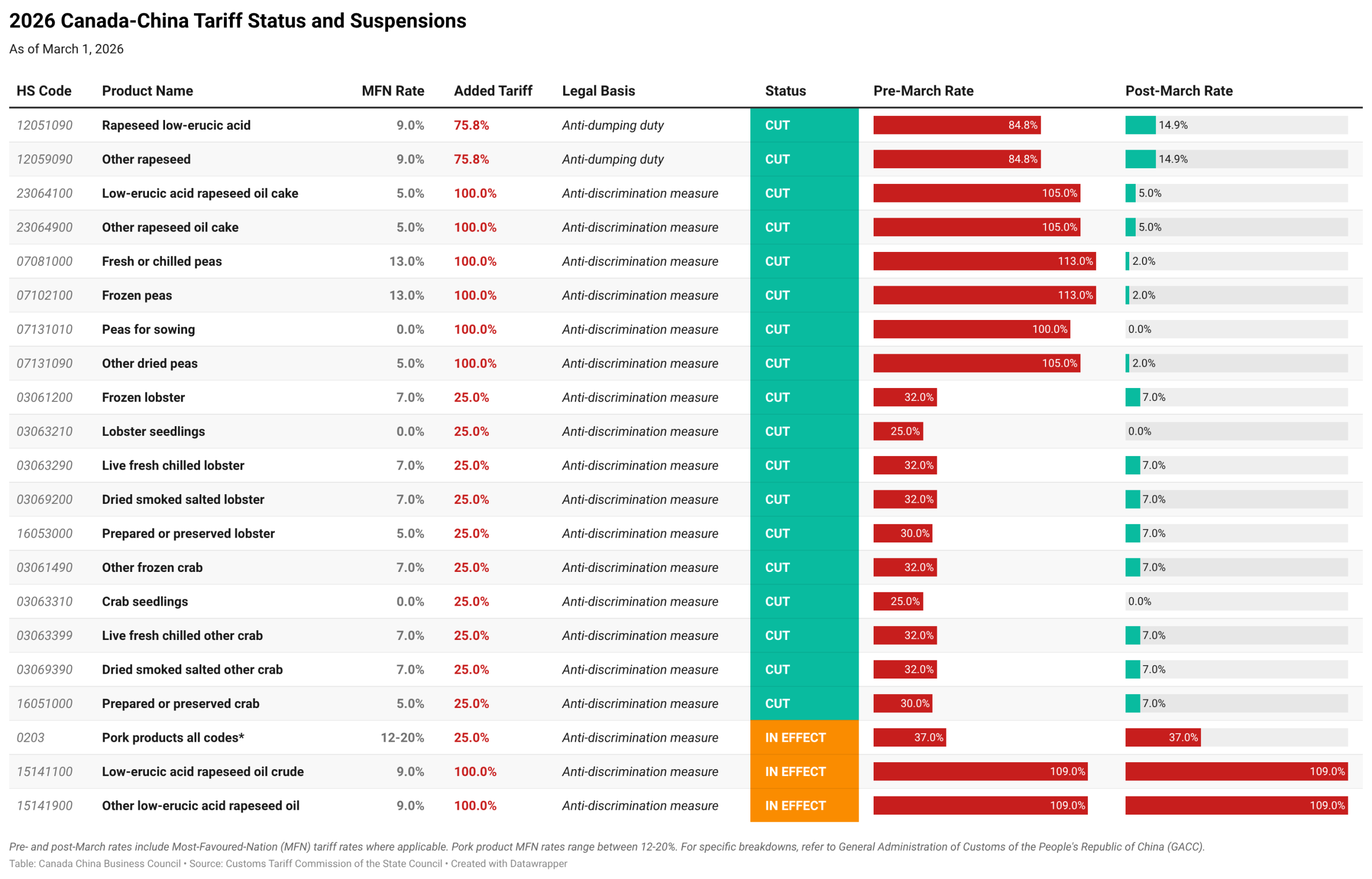
Effective March 1, Beijing announced that a raft of previously-imposed tariffs on Canadian goods are reduced or suspended. The shift comes in tandem with Ottawa’s removal of 100% tariffs on Chinese electric vehicles. With the changes in places, Canadian exporters can expect greater market access and export competitiveness, with Chinese demand set to influence production planning and long-term contracts in the agrifood sector.
In a press release, the federal government stated that the cuts will “improve market access for approximately $4 billion in annual Canadian exports” and directly impact Prairie farmers as well as Pacific and Atlantic coast seafood producers. Ottawa also linked the development with the resumption of Canadian beef and pet food products permitted into the Chinese market and broader efforts to diversify Canadian trade.
Manitoba Premier Wab Kinew welcomed the tariff resolution, but added that “we’re going to keep working with the federal government and keep pushing forward and hopefully we can see some positive news on the pork side too soon.” Daryl Fransoo, Chairman of the Wheat Growers Association, stressed that “restoring more predictable access to China provides needed relief on prices and cash flow at a critical time.”
Cabinet ministers also recognized the downstream impacts of the reciprocal tariff cuts on business-to-business engagement in other sectors. Industry Minister Mélanie Joly stated that the turnaround “will open new commercial and investment opportunities, and position Canada as a reliable partner in next-generation vehicle manufacturing.” In a press interview, CCBC Chief Representative in Beijing David Perez-Des Rosiers noted that “the constant engagement of the business community on both sides has made it possible to face the storms.”
Suspended levies on seafood and canola meal are timed until the end of 2026 while those on pork and canola oil remain, stemming from anti-discrimination tariffs imposed in response to EV tariffs. Separate anti-dumping measure duties on canola seed were cut in a final ruling by a Chinese Ministry of Commerce investigation.
For Canadian businesses, the tariff suspension creates immediate export windows but requires sector-specific navigation. Agri-food exporters gain restored access for canola seed and seafood through 2026, which enables expanded production planning and contract renegotiation with Chinese buyers. Canadian agrifood exporters can expect an accelerated period of time to lock in supply contracts while demand remains strong through 2027.
Sources
-
Global Affairs Canada — Canada secures renewed market access with China to boost exports and strengthen economic collaboration
-
CTV — ‘A lot more work’: Canadian farmers react to suspension of some canola tariffs from China
-
RealAgriculture — China slashes anti-dumping tariff on Canadian canola seed
-
Shenzhen TV — Canadian companies eye deeper cooperation with China as ties thaw, says CCBC Beijing chief
-
Chinese Ministry of Commerce — Final determination on the anti-dumping investigation of imported rapeseed originating from Canada